BITCOIN
PRICE

Track the Bitcoin price. Understand the asset. Start investing from CHF/€50 with Europe’s #1 Bitcoin app.

202603 QR Code WebQR EN black
Scan the code with your smartphone to download the app.
bitcoin price mob

THE BITCOIN PRICE TODAY


BTC / USD
BTC / EUR
BTC / CHF
24h Change
Market Cap
24h Volume
Circulating Supply
Max Supply 21,000,000 BTC
Timeframe Price change Percentage change
Day
Week
Month
6 months
Year

WHAT MOVES THE BITCOIN PRICE?

1
1

Supply & Demand

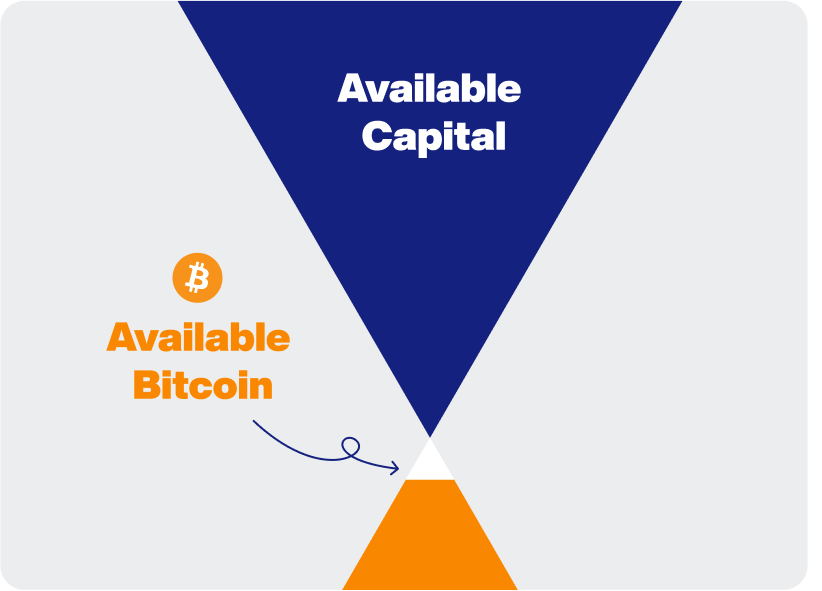
When buyers outnumber sellers, the price rises. With a hard cap of 21 million coins, increasing demand meets decreasing new supply.

2
2

Global Exchange Activity

Bitcoin trades on thousands of exchanges worldwide, 24/7. Prices vary slightly across platforms, and arbitrage keeps them in sync.

3
3

Halving Events

Roughly every four years, miner rewards are halved. This supply shock historically precedes major bull runs as scarcity increases.

3
4

Macro & Regulatory News

Central bank policies, regulation changes, and geopolitical events all influence sentiment and drive short-term price action.

WHY BITCOIN

glass half

Only 21 million Bitcoin will ever exist. Every four years, the halving cuts new supply in half, making it the scarcest asset on the planet.

globe

Send value anywhere on earth, 24/7, without banks or borders. Bitcoin settles in minutes, not days.

arrow up right

Despite short-term volatility, Bitcoin has outperformed every other major asset class over the past decade.

graph down

Fiat currencies lose purchasing power every year. Bitcoin’s fixed supply makes it an attractive store of value in uncertain times.

safe

With Bitcoin, you truly own your money. No bank can freeze your account or deny you access. Your keys, your coins.

running

From merchants to governments, acceptance is accelerating. The Lightning Network makes everyday payments instant and nearly free.

Why you should buy Bitcoin from Relai

swiss logo
swiss logo

A trusted app developed in Switzerland

bitcoin logo
bitcoin logo

Focused exclusively on Bitcoin

usb
usb

Full control of your BTC with a non-custodial wallet

home security phone

The most important facts about Bitcoin

Bitcoin is not only the first cryptocurrency but also the best-known and most widely used. Since its launch in 2009, Bitcoin has undergone an impressive evolution, marked by both ups and downs. These milestones demonstrate the unique and dynamic nature of the digital currency.

2009Bitcoin was officially launched after Satoshi Nakamoto published the Bitcoin Whitepaper in October 2008. The first transactions take place among early developers and enthusiasts.
2010On May 22, Laszlo Hanyecz paid 10,000 BTC for two pizzas, the first known commercial transaction using Bitcoin. The day is now celebrated as “Bitcoin Pizza Day”.
2011Bitcoin reached parity with the US dollar for the first time, and the first major exchange hack (Mt. Gox) highlighted the risks of early infrastructure.
2012Bitcoin experienced its first halving, reducing mining rewards from 50 to 25 BTC, and WordPress became one of the first major platforms to accept Bitcoin payments.
2013Bitcoin broke $1,000 per BTC for the first time, indicating growing public interest.
2017The price reached $19,666 per BTC, driven by cryptocurrency hype, before crashing again.
2018After the hype, the price dropped below $3,000, illustrating the market’s volatility.
2019Bitcoin rebounded to nearly $14,000 mid-year amid growing institutional infrastructure, before settling around $7,200.
2020Despite a pandemic-induced crash in March, Bitcoin surged past $29,000 by December as institutional investors, such as MicroStrategy, entered the market.
2021Bitcoin hit an all-time high of $69,045, driven by institutional investment and broader adoption.
2022The price fell below $20,000 again but stabilized by the end of the year.
2023A period of recovery and stability, with Bitcoin continuing to be viewed as digital gold.
2024Bitcoin reached a new all-time high of over $108,000, driven by institutional investment and positive market sentiment.

What is Bitcoin?

Bitcoin is the first and most famous cryptocurrency, created in 2009 by an anonymous person or group under the pseudonym Satoshi Nakamoto. It is a digital currency that works independently of central institutions such as banks or governments. Bitcoin is based on a decentralized network that ensures security, transparency, and traceability.

The key features of Bitcoin:

1

Bitcoin is not controlled by a central authority. Instead, it is based on a peer-to-peer network in which all participants act on equal terms. Transactions are validated and stored by computers (nodes) worldwide, making manipulation almost impossible.

2

Bitcoin transactions are stored on the blockchain, a public, decentralized ledger. Every transaction is secured and permanently stored using a cryptographic process. This ensures a high level of transparency and security.

3

Unlike fiat currencies, which can be printed indefinitely by central banks, the maximum amount of Bitcoin is up to 21 million coins limited. This limited supply makes Bitcoin a scarce digital asset, comparable to gold.

4

Bitcoin was created as an alternative to traditional financial systems, especially for people living in countries with unstable currencies or limited access to banks. It offers the ability to store and transfer value without middlemen.

5

Bitcoin transactions are secure and pseudonymous. Although all transactions are publicly stored on the blockchain, users’ identities are protected by cryptographic keys, making it challenging to link wallet addresses to real-world identities without additional information.

6

Bitcoin knows no geographical boundaries and can be sent worldwide in minutes. This makes it an ideal solution for international payments, especially in regions with high transaction costs at traditional banks.

7

Many consider Bitcoin a form of “digital gold” because it offers a way to store value over the long term, especially during times of inflation or economic uncertainty.

How does Bitcoin work?

coins

New Bitcoins are created through a process called mining. Miners use specialized hardware to compute cryptographic hashes, searching for one that meets Bitcoin’s current difficulty target. This validates transactions and adds new blocks to the blockchain. For this work, miners receive Bitcoin as a reward.

globe

Users can send and receive Bitcoin using a digital wallet. Every transaction is verified by a network of computers and stored on the blockchain. This ensures trust without the need for a middleman, such as a bank.

glass half

Approximately every four years, the reward for miners halves, reducing the supply of new Bitcoins. This so-called Halving often has an impact on the price of Bitcoin as it increases scarcity.

Why was Bitcoin developed?

Bitcoin was created at a time when many people had lost trust in the traditional financial system – particularly after the global financial crisis of 2008. The vision behind Bitcoin was to create a system that:


  • Works independently of banks and governments,
  • is secure, transparent and tamper-proof,
  • Offers people around the world an opportunity to transfer value without restrictions.

What is Bitcoin used for?

wallet

Bitcoin is being accepted by an increasing number of merchants and businesses worldwide, both online and offline. It can be used for everything from small purchases to large transfers.

candlestick chart

Many people buy Bitcoin as a speculative asset or long-term investment, hoping for further appreciation.

graph down

In countries with unstable currencies, Bitcoin is often used as a safe-haven asset to protect individuals’ wealth.

What makes Bitcoin unique?

Bitcoin is more than just a digital currency – it is a technological revolution. It has laid the foundation for a new era of cryptocurrencies and decentralized systems that have fundamentally changed traditional finance and the way we transfer value.

Why do people invest in Bitcoin?

safe

Like gold, Bitcoin is often viewed as a hedge against inflation because its supply is limited.

arrow up right

Despite its volatility, Bitcoin has shown impressive appreciation over the past decade.

egg

As an asset class, Bitcoin offers a way to diversify a portfolio and spread risk.

running

Many believe that Bitcoin will continue to increase in value in the long term as adoption increases worldwide.

Frame 1321322760

What influences the Bitcoin price?

The interplay of supply and demand determines the Bitcoin price and is heavily influenced by activity on global cryptocurrency exchanges. Since there is no central institution that controls the price, the price is determined solely by market forces. Various factors play a crucial role in pricing.

Firstly, the price of Bitcoin is determined by the dynamics between buyers and sellers. When more people want to buy Bitcoin than there are for sale, the price rises. Conversely, an oversupply of Bitcoin or lower demand leads to a drop in price. This makes the market extremely volatile and prone to rapid price movements.

Another important influencing factor is this limited supply of Bitcoin. There will only be 21 million Bitcoins in total, a characteristic that makes Bitcoin a scarce digital asset. This artificial limit ensures that Bitcoin’s value increases as demand rises, since its supply cannot be expanded – a key difference from fiat currencies, whose supply can be increased at will by central banks.

Since Bitcoin is traded on numerous exchanges worldwide, there is no uniform reference price. Each exchange has its own rate, which depends on factors such as trading volume and liquidity. Aggregated data from platforms such as CoinMarketCap or TradingView provide average values, but slight price deviations between exchanges are common.

Additionally, marketplace intermediaries and fees impact pricing. Many platforms charge transaction fees, which affect the final price for buyers and sellers. Arbitrage, i.e., trading between different exchanges, can also compensate for smaller price differences.

In summary, the Bitcoin price is driven by a complex interplay of scarcity, demand, trading activity, and external costs. These mechanisms make Bitcoin unique but also vulnerable to price fluctuations.

Should you still buy Bitcoin now?

Despite its volatility, Bitcoin has proven to be one of the best-performing asset classes in recent years. However, you should make a few considerations:

eye

Bitcoin is being accepted by an increasing number of merchants and businesses worldwide, both online and offline. It can be used for everything from small purchases to large transfers.

egg

Many people buy Bitcoin as a speculative asset or long-term investment, hoping for further appreciation.

graph down

In countries with unstable currencies, Bitcoin is often used as a safe haven to protect savers from losing their wealth due to currency debasement.

FAQ

picturesque view on bachalpsee lake in swiss alps 2025 02 21 18 47 34 utc